


Tradeshows do a great job showing what’s possible. But it’s easy to get distracted with the newest shiny thing. What’s possible is not always what’s feasible for your operation.
Most of what you see on the show floor or marketed elsewhere has been proven somewhere. The question is whether it has been proven in an environment that looks like your plant. You may have site constraints, shared or limited resources, or inconsistent flow that will certainly affect what you can use. And regardless of your unique situation, the reality is that production drives everything, so your options are not unlimited.
If you keep this in mind, a different picture starts to emerge. Some technologies are ready and delivering value in plants today. Others are still catching up to the complexity of manufacturing environments.
This is a practical way to sort through that.
Start with a simple filter: Does the automation product fit how your plant runs?
A lot of what’s on display at a trade show was built for distribution. That doesn’t make it wrong, but it does change how it performs in a plant.
Manufacturing environments introduce scenarios that are difficult to replicate in a demo, such as:
- Variable production rates across lines
- Frequent changeovers and SKU shifts
- Tight coupling between processes
- Limited space and fixed infrastructure.
If a solution assumes consistency, it may struggle in a plant that is anything but.
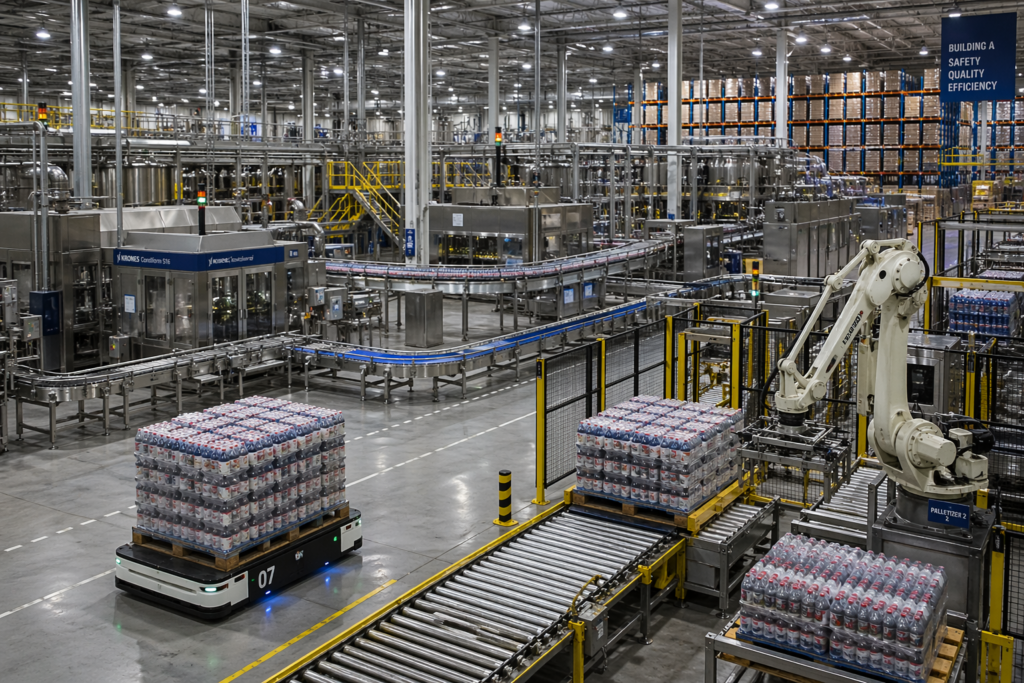
Where manufacturers should focus:
AGVs and AMRs for Line-Side Movement
These are everywhere, and for good reason. They are one of the more applicable technologies for manufacturing, especially for pallet movement and line feeding.
Where they work well today:
- Repetitive point-to-point moves
- Stable pickup and drop-off locations
- Clear separation between pedestrian and vehicle traffic
Where teams run into trouble:
- Treating autonomy as a substitute for process discipline
- Underestimating congestion in shared spaces
- Expecting the system to adapt to variability that isn’t controlled upstream
The most successful deployments tend to look less “autonomous” than expected. Routes are structured and interactions are defined. The system is predictable.
That’s not a limitation. That’s what makes it reliable.
Robotic Palletizing and Depalletizing
This is one of the more mature and widely applicable areas for manufacturing.
Palletizing, in particular, is well established and continues to improve, especially with more flexible end-of-arm tooling and better handling of mixed cases.
Depalletizing is improving but still more sensitive to product variability, packaging inconsistencies, and layer stability. When analyzing a system, note how it handles variation as well as changeover time between SKUs or patterns and how tightly it integrates with upstream production rates.
To determine if either system is a candidate for your operation, evaluate how well it fits your specific product mix.
Pallet AS/RS as a Buffer, Not a Replacement
High-density pallet AS/RS systems are becoming more relevant in manufacturing, especially where space is constrained.
They are most effective when used as a production buffer between processes, rather than a replacement. These systems can provide a way to decouple lines from downstream variability, or become a tool to stabilize flow, not just store inventory.
Expectations can drift if you find yourself doing the following:
- Treating it as a complete solution for all storage and movement
- Underestimating the integration required with production scheduling and release logic
- Missing the infrastructure requirements in existing buildings
In established plants, the physical and operational fit matters as much as the technology itself.
Vision Systems for Quality and Verification
Vision systems are advancing quickly and are becoming more accessible for plant-level applications.
They deliver value in the following areas:
- Quality inspection and defect detection
- Label verification and compliance checks
- Basic guidance for robotic systems
Be cautious when faced with these situations:
- Highly variable product presentations
- Environments with inconsistent lighting or conditions
- Applications that require significant data training before stabilizing
Vision works best when the environment is controlled. Otherwise, it takes more effort to maintain performance.
Where to Apply More Scrutiny
Autonomy
There is a strong push toward fully autonomous systems, but this is often overvalued. In practice, most manufacturing environments benefit more from controlled, predictable systems rather than highly adaptive ones.
The goal is consistent, repeatable performance within your operating constraints. Maximum autonomy may or may not get you there. If a system relies on adapting to chaos, it usually means the underlying process has not been stabilized.
Integration
Very little of what you see on the floor operates in isolation once it is deployed.
The real work shows up in the following areas:
- Connecting to production schedules
- Coordinating between lines and shared resources
- Managing data across systems
- Handling exceptions in real time
This is where timelines extend and where performance gaps tend to appear. Any technology that looks simple on the floor should be evaluated for how it ties into your existing operation.
Infrastructure
Do not ignore existing infrastructure. Brownfield plants introduce real constraints that don’t show up in a booth, such as:
- Floor conditions and flatness
- Power availability and distribution
- Space limitations and column spacing
- Existing equipment that cannot move
These are not minor details. They shape what is feasible.
A solution that fits cleanly in a demo may require significant enabling work to function in your facility.
A Grounded Way to Approach Available Technology
If you look for the most advanced technology, you will find plenty of it online and on the floor at trade shows.
If you approach your search looking for what will actually improve your operation, the options become more manageable.
Focus on these areas:
- Technologies that align with how your plant already runs
- Solutions that prioritize stability over complexity
- Systems that acknowledge the realities of integration and infrastructure
The goal is not to find the most impressive system. It is to find the one that will still perform six months after go-live.
Foth Provides Common Sense
If you want to talk through how available technologies apply to your plant, contact us.
And bring your constraints. We can discuss what translates well into manufacturing environments and where things get more complicated.
No pitch. Just a practical conversation grounded in how these systems actually perform once they’re installed.
 Kyle Nadler
Lead Distribution & Logistics Specialist
Schedule a call with me
Markets: Consumer Products, Food and Beverage, Manufacturing and Industrial Products, Pulp and Paper
Services: Distribution Logistics Systems
Related Insights
Creating a Culture of Belonging: Why Relationships Matter During Onboarding
Author: Margaret Baltus, Senior Organizational Development Leader
Hazardous Materials in Facility Design: Why Early Decisions Matter
Author: Shannon Standish, AIA, NCARB


