

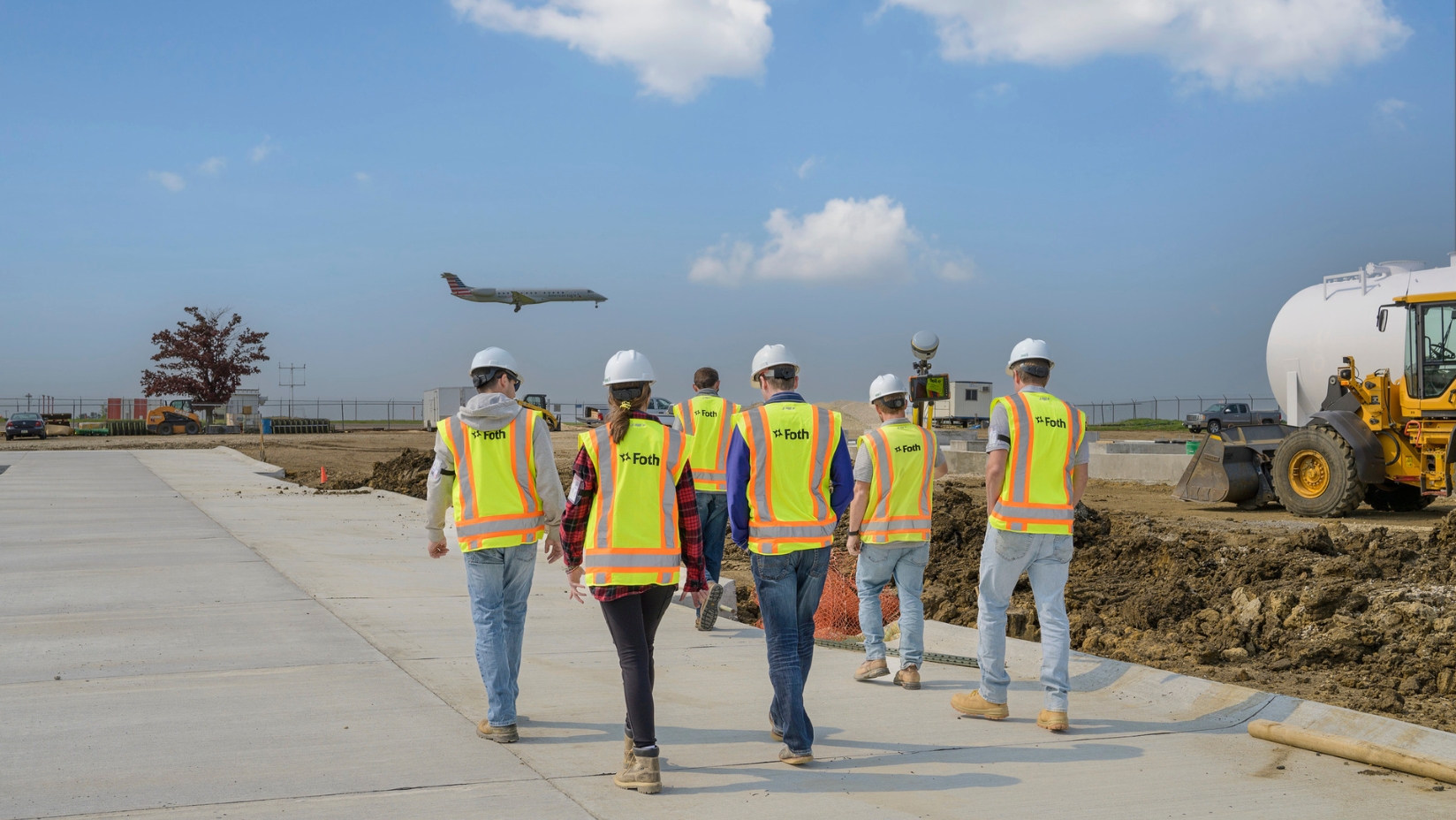
When it comes to airport construction safety, anyone entering an airport runway, apron, or taxiway must have a heightened awareness of the environment while also adhering to stringent security requirements. When a construction project is underway, a variety of contractors and crew are required to share an already hazardous space without converging. Diligence in a few areas noted here can safeguard everyone from personnel to passengers.
Airport Access and Gate Security
Any unescorted individual wishing to enter the airfield must complete a vetting process and receive an access/identification badge. To access the airfield perimeter gate or gain access to secure portions of airfield facilities, personnel must scan their badge. After entering, they must ensure that the gate or door closes completely and prevent anyone else from following through, a practice known as “piggybacking.” The same procedure applies when exiting. We’re all tired at the end of the workday and want to get home. Don’t be in a hurry and neglect to wait for the gate to close completely. This is a big infraction.
Some personnel have escort privileges, as indicated on their badge, and may accompany guests. Escorted guests must remain with authorized personnel at all times and stay within sight and communication range.
Airfield Driving, Movement Safety, and PPE
Annual construction safety training is required by Foth for all those working on a construction site. Specialized training is required by the airport in order to possess an access/identification badge for those working in aircraft taxi and runway spaces. Still, the following precautions cannot be overemphasized:
- Common practice is to assume that nobody sees you when you’re navigating the airfield. Yield to everyone, from tugs to field vehicles.
- Yield to aircraft at all times!
- If you see a red light on the right side of an aircraft, and a green light on the left side, this means an aircraft is moving toward you.
- Airports have designated routes for tugs, baggage carts, and fuel vehicles. When available, stay on the service lanes.
- Maintain low driving speeds.
- Eliminate distractions such as phone use.
- Never travel behind active jets because of jet blast hazards.
- Wear appropriate equipment PPE such as safety glasses, hard hat, and vests, and follow other job-specific precautions.
Foreign Object Debris (FOD) and General Safety Awareness
One of the most significant ongoing safety concerns at airports is foreign object debris (FOD). FOD can be anything that can become airborne, from dirt, gravel, and baggage tags to screws and insulation. FOD can create serious hazards for aircraft operations, Foth emphasizes to our team and to contractors the importance of maintaining clean work areas, securing loose materials during construction, and reporting debris immediately if it is spotted in areas that cannot be accessed directly.
Role of On-Site Support in Airport Projects
Foth team members involved in airport design and construction provide on-site support throughout a project. They oversee field activities, answer questions, monitor progress, and serve as a link between job site conditions and office-based design teams. This on-site role helps identify issues early, improve communication, and support high-quality outcomes for clients.
Airport projects may include the construction or reconstruction of taxiways, aprons, and runways, as well as vertical projects such as terminal expansions or new hangar construction. Regardless of project type, close coordination among engineering teams, field personnel, and contractors is essential to maintain project integrity, job site safety, and the security requirements unique to airport work.
Markets: Airports
Services: Aviation Services, Construction Services
Related Insights

Creating a Culture of Belonging: Why Relationships Matter During Onboarding
Author: Margaret Baltus, Senior Organizational Development Leader
Parking Capacity Challenges and Expansion Strategies for Southeast Airports
Author: Nick Harwell


