

For decades, manufacturing network decisions were largely driven by volume and efficiency. Companies optimized production footprints around labor availability, logistics costs, asset utilization, and economies of scale. Once facilities were built and production lines were established, networks often remained relatively stable for years.
That approach no longer works on a widespread scale.
Consumer preferences are evolving faster than ever. Entire product categories can emerge, mature, and transform within a handful of years. At the same time, changing regulations, ingredient requirements, sustainability expectations, and labeling standards are forcing manufacturers to rethink how and where products are made. What was once a production challenge is increasingly becoming a network challenge.
Today, manufacturers are discovering that success is not determined by the efficiency of a single facility. It is determined by the flexibility of an entire manufacturing network.
The Market Has Changed. Has Your Footprint?
Many manufacturing networks were designed to support demand patterns that no longer exist.
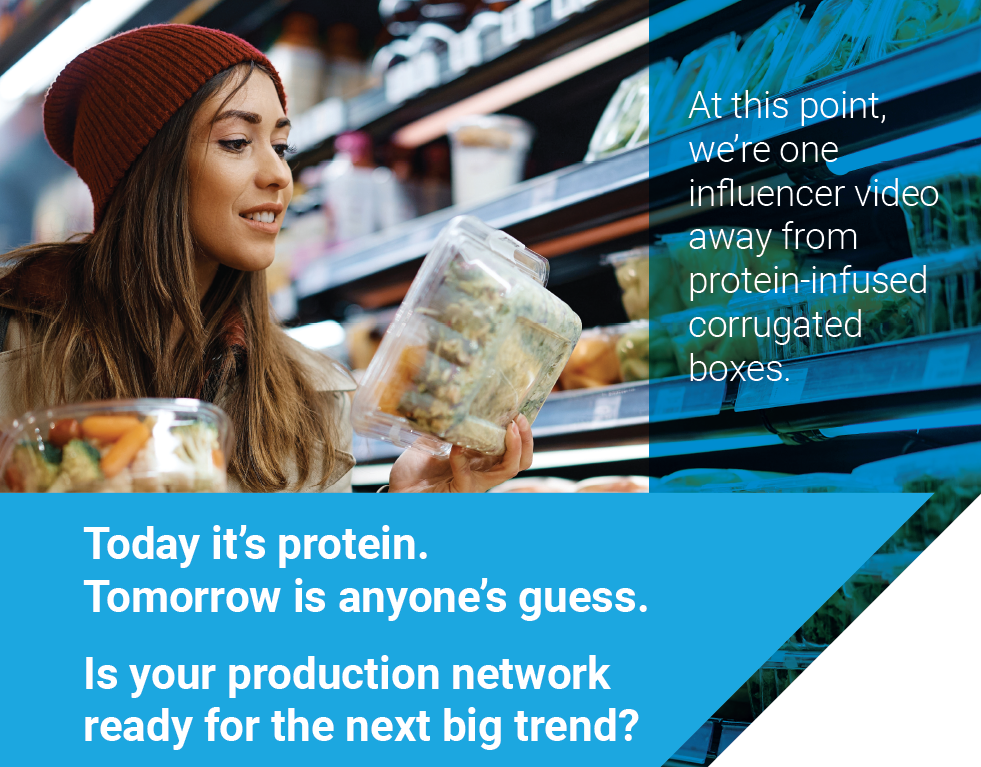
Food and beverage manufacturers provide a compelling example. Over the last several years, consumer demand has shifted dramatically toward products marketed as high protein, functional, fortified, clean label, low sugar, allergen conscious, or nutritionally optimized. Products that were once niche offerings now occupy entire sections of grocery stores.
Consider the growing demand for protein-enriched products. Protein is no longer limited to sports nutrition powders and bars. Today it appears in beverages, snacks, breakfast foods, frozen meals, and even desserts. Manufacturers have been forced to rethink formulations, ingredient sourcing strategies, packaging requirements, and production capabilities to keep pace.
The challenge is that many existing facilities were never designed to produce these products.
Adding a new ingredient is rarely as simple as modifying a recipe. Higher-protein formulations often require different processing equipment, additional ingredient handling systems, enhanced quality controls, specialized storage solutions, modified sanitation procedures, and new packaging formats. What begins as a product innovation initiative quickly becomes a capital planning and manufacturing strategy discussion.
Eventually leaders begin asking larger questions:
- Which facilities should support future growth categories?
- Where should new capacity be added?
- Which assets can be repurposed?
- Are existing production networks positioned to support future demand?
At that point, the conversation shifts from production optimization to network transformation.
Regulatory Change Often Accelerates the Need for Action
Consumer demand is only one side of the equation.
Regulatory changes can quickly alter investment priorities and accelerate decisions that organizations may have been postponing. New nutrition guidance, labeling requirements, allergen declarations, ingredient transparency expectations, packaging regulations, environmental mandates, and sustainability initiatives all influence how products are manufactured and distributed.
In many cases, these requirements expose limitations within existing facilities.
An aging plant may be capable of producing today’s products but require significant upgrades to remain compliant with tomorrow’s standards. Another facility may already possess the infrastructure, utilities, and space necessary to support future growth.
As a result, manufacturers increasingly find themselves evaluating decisions that extend beyond individual projects:
- Should a facility be retrofitted?
- Should production be consolidated?
- Should assets be relocated?
- Should operations be expanded elsewhere?
- Does it make sense to establish a new center of excellence?
The answer is rarely obvious. However, what is becoming increasingly clear is that waiting often makes the challenge more expensive.
Why Network Transformation Is Increasingly a Brownfield Story
When companies think about transformation, the conversation often gravitates toward greenfield facilities. A brand-new site offers a clean slate, modern infrastructure, and opportunities to implement the latest technologies.
But most manufacturers have invested millions, and often billions, of dollars in existing plants, equipment, utilities, and workforce development. Walking away from those investments is rarely practical.
As a result, many successful network transformations focus on maximizing what already exists.
Brownfield projects allow manufacturers to modernize facilities, repurpose underutilized assets, expand production capabilities, and improve operational flexibility without completely rebuilding from scratch. Existing production assets can often be relocated, upgraded, integrated, or reconfigured to support evolving demand while minimizing disruption to ongoing operations.
This approach requires careful planning, but it frequently delivers a stronger return on investment while reducing execution risk.
The most successful manufacturers are not necessarily the ones building the newest facilities. They are the ones making the smartest decisions about the facilities they already have.
The Rise of Manufacturing Centers of Excellence
One of the most common outcomes of a network transformation strategy is the creation of manufacturing centers of excellence.
As product portfolios become more complex, organizations increasingly recognize the value of concentrating specific capabilities within strategically selected locations.
Rather than attempting to make every plant capable of producing every product, manufacturers are focusing facilities around specialized strengths.
Examples include:
- Protein processing and formulation hubs
- Functional beverage production centers
- Allergen-free manufacturing facilities
- High-speed packaging operations
- Advanced automation sites
- Specialized ingredient processing locations
This strategy allows organizations to centralize expertise, maximize asset utilization, standardize processes, and improve quality outcomes. It also creates a foundation for future innovation by establishing dedicated facilities that can more easily accommodate changing production requirements.
Most importantly, centers of excellence create flexibility across the broader network.
Moving From Reactive Projects to Strategic Transformation
Historically, many capital projects have been initiated in response to immediate needs. A line reaches capacity. A product launch requires new equipment. A regulation creates a compliance gap.
While those projects may address short-term challenges, they do not always solve the larger strategic problem.
Network transformation requires organizations to take a broader view.
Instead of focusing solely on individual facilities, leaders must evaluate how products, customers, regulations, supply chains, workforce availability, and capital investments interact across the entire manufacturing footprint.
The organizations that excel at this work focus on a few critical questions:
- Which products are likely to drive future growth?
- Where is demand changing most rapidly?
- Which facilities constrain that growth?
- Which facilities create opportunity?
- How flexible is the current network?
- Which assets can be repurposed to create value?
The answers often reveal opportunities that would remain hidden within a traditional project-by-project planning approach.
Flexibility Has Become a Competitive Advantage
The pace of change facing manufacturers shows no signs of slowing.
Today’s conversation may center on protein-enriched foods, new nutrition requirements, allergen regulations, or sustainability initiatives. Tomorrow it could focus on entirely different consumer preferences, market demands, or regulatory expectations.
The specific trend matters less than the underlying reality: change is a constant.
Organizations that build plans for their flexible manufacturing network will be better positioned to adapt, innovate, and grow regardless of what comes next. Those that continue relying on footprints designed for yesterday’s market may find themselves struggling to keep pace.
Network and footprint transformation is no longer simply an operational exercise. It is a strategic imperative.
Because the question is not whether demand will change. The question is whether your manufacturing network can change with it.
Markets: Consumer Products, Food and Beverage, Manufacturing and Industrial Products, Pulp and Paper
Services: Engineering for Product Manufacturing, Manufacturing Reshoring
Related Insights
How Food Facility Design Can Improve Allergen Control and Prevent Cross-Contact
Author: Mark E. Redmond, P.E.

Creating a Culture of Belonging: Why Relationships Matter During Onboarding
Author: Margaret Baltus, Senior Organizational Development Leader


