Reflections on receiving the Bob Dean Coastal Research Award, a career shaped by fieldwork and curiosity, and advice for the next generation of ocean and coastal engineers
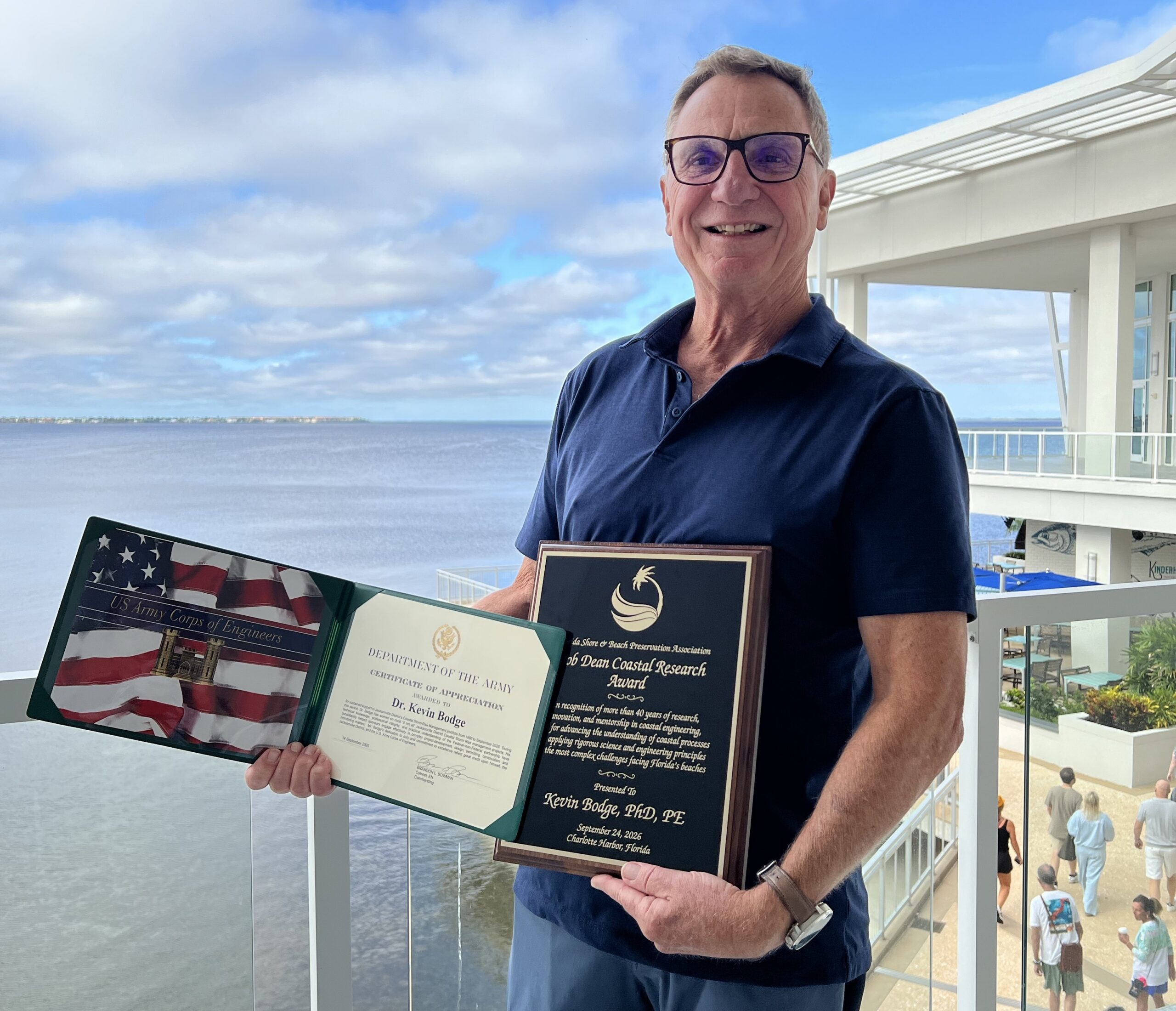
I am deeply honored to receive the Bob Dean Coastal Research Award from the Florida Shore and Beach Preservation Association. This professional recognition is especially meaningful because it bears the name of my long-time mentor. I appreciate the colleagues who consider my work worthy of an award associated with him.
An Unexpected Path
I grew up moving from coast to coast and overseas before graduating from high school in Pittsburgh. I was good at math and science, but what really drew me toward engineering was the chance to apply them. As an amateur radio operator, I became fascinated with electronics and building things. I ultimately taught myself computer programming in the 1970s. Through my U.S. Navy family, I inherited a love for the ocean and early in life became an avid scuba diver.
There were few undergraduate programs in ocean engineering then, so I studied aerospace engineering since both fields are grounded in fluid dynamics. I went to graduate school because advanced study was the practical doorway into ocean-related work. I did not have a grand career plan. I knew I liked mathematics, physics, mechanical work, and the ocean, and I was willing to pursue challenges when they appeared.
The Mentor Who Taught Me How to Think
At the University of Delaware, I met Bob Dean. He brought me on as one of his master’s students in 1980. I knew immediately that I wanted to work for him. He was extraordinary to be around, although I did not yet appreciate that he was already one of the preeminent coastal engineers in the world.
Bob quickly recognized that I had a practical grasp of mechanical problems. Within weeks, he took me to Santa Barbara to help with a field experiment. The following summer, he sent me to Virginia Beach to run another experiment. Those experiences taught me to survey coastlines, work above and below the water, improvise when equipment failed, and connect equations to the physical world.
Together we developed and patented the differential pressure gauge directional wave monitor, or DPG. At the time, measuring ocean wave direction required massive instruments deployed by a large boat and a team of divers. Ours was small enough for me to carry on my shoulder and tow behind my sports car. It was significantly more precise than the prevailing equipment, although a new generation of smaller pressure sensors soon overtook it in the marketplace.
Next, I followed Bob to a wave laboratory in Norway as his assistant before becoming his doctoral student at the University of Florida. Over roughly six years working with him, I conducted field and laboratory research, taught undergraduate courses, and learned to take responsibility for problems without waiting for someone else to map every step. Bob might give a student a difficult assignment and then disappear into his own work for weeks. The expectation was clear: understand the fundamentals, use every available tool and come back having thought deeply. It was an honor, but it was exhausting. We worked 80-plus hour weeks.
What Bob taught me — and how he taught — has guided me throughout my career, from the classroom and consulting work to mentoring colleagues. He taught us to combine advanced mathematics with field observation and common sense. Rather than simply provide answers, he showed us how to break down problems and recognize when a solution did not align with the physical world.
Three Months That Became 38 Years
When I finished my doctorate in Gainesville, I was exhausted and still had no particular plan. A friend called from Olsen Associates in Jacksonville with an assignment no one had quite done before. Erik Olsen, also a former student of Dr. Dean, needed someone to develop a practical numerical model for a coastal problem, and the job was expected to last two or three months. I said yes. That temporary assignment became a 38-year career.
My first major project involved Hilton Head Island in South Carolina and perhaps the earliest practical application of numerical modeling in private coastal engineering practice. Desktop computers were only beginning to emerge, so I developed the code from scratch to predict how waves would move along the coast and transport sand. The model was built on an extremely limited computer by today’s standards, yet its predictions have held up remarkably well. That pioneering work taught me that a model is only valuable when it is informed—and challenged—by field experience and physics.
The Field Has Changed — The Physics Has Not
Coastal engineering remains grounded in the same physical forces I encountered at the beginning of my career: waves, currents, sediment, wind and the interaction of water with the built and natural environment. What has changed dramatically is our ability to observe these forces. Early in my career, surveying a beach involved rudimentary equipment and hard physical work. Today, GPS, drones, remote sensing, and autonomous vehicles can map a coastline with speed and precision we could scarcely imagine.
The availability of aerial imagery has been equally transformative. I can study a remote shoreline, then move backward through decades of images to see how it changed. Collecting that history once required months and considerable expense. Now it’s available in seconds. For an engineer working around the world, that access is an extraordinary advantage.
At the same time, technology can become a substitute for judgment. Too many engineers begin with a computer model rather than with preliminary speculation of the probable answers. Models are useful for estimating how water or waves may move, but they are imperfect representations of sediment transport and complex oceanographic systems. Understanding these topics requires experience-based intuition.
The education and structure of the profession have changed, too. My generation learned through case studies, technical literature, mathematics, and sustained exposure to the field. Private coastal engineering practice was still small, and much of the strongest research was being done by universities, the U.S. Army Corps of Engineers, and the Navy. As private practice expanded, more projects were completed, and many longstanding shoreline problems were addressed. Yet this growth ultimately reduced research opportunities and funding, likely weakening graduate education and public-sector expertise.
A big positive change I’ve witnessed is a greater recognition of the fragility of coastal systems and the need to defend them in the certainty of rising sea levels. It’s a tough challenge. I hope more people enter the business to solve the problem in a practical way.
Advice for Those Who Come After
Throughout my career, I’ve tried to look at every problem or assignment backwards. I suggest this method to ocean and coastal engineers who are starting out in the field: First, focus on the end goal or user, not the process to get there. When writing a report or preparing a graphic, put yourself in the place of the person who will be looking at it—a regulator, client, layman or legislator — and ask what that person really needs or cares to know and what they can understand. That’s engineering for the audience, not the author. When developing a project solution, start with lots of observing — looking, walking, and swimming — then skip to possible solutions and work backwards to see whether a plausible solution might work. Re-test it with fresh eyes to see if it still makes sense or to discover how to refine it. As Dr. Dean taught us, you can quickly get to a 70% solution by considering the fundamental physics; the last 30% — the perfection and details — is the long and hard part. Sometimes, 70% is enough to get a job done or move the project quickly to the next level.
Engineering as Environmental Stewardship
I have been fortunate to have one of the most rewarding careers a coastal engineer could hope for. Over the decades, my team has diagnosed erosion, designed restoration projects, prepared construction and permitting documents, and monitored long reaches of shoreline throughout the Southeast. In many places, we began with beaches eroded back to seawalls and bulkheads. Restoring those coastlines required science, design, dredging expertise, legislation, litigation, public education, and persistence.
Hilton Head was the first major program of my consulting career, and it became part of a much larger body of beach and inlet management work. We helped restore natural systems, improve the way navigation projects accounted for adjacent beaches and advance coastal management approaches that spread across Florida, the Carolinas, and Alabama. Much of this work is nearly invisible by design. People arrive at a beach and assume it has always been there. They do not see the decades of engineering, policy, and maintenance behind it.
That invisibility does not lessen the satisfaction. My favorite day is going to a beach that was not there — or was barely usable — when I began working, and watching a child build a sandcastle or a family fish along the shore. That is a simple scene, but it represents environmental stewardship, public access, local economies, and years of people working together. It makes me think, yes, this is good.
International resort work gave me another kind of education. On those projects, the coastal engineer is only one contributor among architects, landscape planners, civil and mechanical engineers, interior designers, operators, and many others. Success requires understanding the whole vision rather than defending a narrow specialty.
My interests in theater, drawing, and cartooning have helped me communicate, teach, and see design from different angles. My nightstand is filled with the strangest collection of reading material, from history and technology to scripts and newsstand magazines. I often read just to see how the writer makes a story engaging so that I might learn to write better as an engineering consultant.
I encourage other engineers to stretch a little in this way as well. We certainly need technical depth, but creativity and a broader perspective help us communicate that expertise more clearly, so keep learning.
Markets: Waterfront and Marine
Related Insights
From Student to Steward: A Coastal Engineer’s Career and a Mentor’s Lasting Influence
Author: Kevin Bodge, PhD, PE
Creating a Culture of Belonging: Why Relationships Matter During Onboarding
Author: Margaret Baltus, Senior Organizational Development Leader