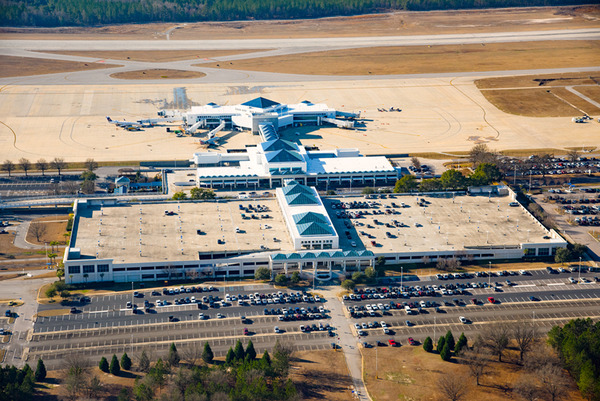
For airport administrators and airline travelers nationwide, parking has become a persistent pressure point. Commercial service airports in the Southeast, particularly those that serve beach and leisure destinations, face a unique set of challenges: demand now extends well beyond peak holidays and the traditional summer travel season, and growth in tourism, population shifts, and travel patterns (notably reshaped by the pandemic) have pushed parking systems beyond what many airport campuses were originally designed to accommodate.
A myriad of options and hybrid solutions are being used and explored, from premium parking and shuttle services to parking guidance technology and multi-level parking. No single solution applies to every facility, so pleasing passengers while maintaining optimal function requires creative thinking and planning, not simply for the present but also for the future.
Keep reading for a breakdown of the parking challenges airports are facing and a few approaches worth keeping on the radar:
Parking Challenges Specific to the Southeast
Airports in the southeast face a distinct combination of constraints. In Florida, for example, many passengers are traveling through airports to reach beaches, resorts, cruise ports, and second homes. While leading a study for the Florida Department of Transportation that evaluated the impact of the pandemic on Florida’s airports, my former team noted the effect on smaller airport campuses. We discovered that travelers during the pandemic were pivoting from congested sunbelt destinations to Northwest Florida’s white-sand beaches. As these locales and other coastal areas became more popular, the intense seasonal demand overwhelmed small hub airports built for the more modest activity levels of the past. You can view the full FDOT report here.
Such continued demand is compounded by limited land availability. Airports must protect airspace, accommodate aircraft movement and parking areas, terminal operations, while also managing pressure from nearby commercial development. Once an airport campus is boxed in, every new building, roadway, or lot can either preserve future flexibility or further limit it. In fast-growing Southeast markets, the decisions to change the airport footprint must be made with careful intention.
Exploring Surface Parking Expansion Strategies for Growing Airports
Surface parking is often the simplest and first option, but it has limits. Some airports have short-term, covered, long-term, and overflow parking areas and still reach capacity during holiday travel periods. This kind of scenario illustrates the operational strain airports face when passenger volume exceeds available close-in parking.
Rideshare and shuttle options have not eliminated the need for airport parking. More futuristic mobility trends such as autonomous vehicles are not ready for large-scale rollouts. And regardless of the methods to divert traffic within the airport campus, many travelers still value the convenience of returning from a trip, walking to their car, and driving home on their own schedule. For smaller commercial service airports, that expectation can be especially strong because passengers are accustomed to a relatively easy-in, easy-out experience.
Saving Space for Airport Parking by Going Vertical
When land is limited, vertical parking sounds like a logical solution. Parking garages can add significant capacity without consuming the same footprint as surface lots, and they can protect passengers from heat, rain, and severe weather.
Vertical parking is expensive and technically complex, however. In coastal and sandy environments, geotechnical conditions drive design decisions. Soil bearing capacity, piling requirements, stormwater management, and the presence of unstable materials such as muck (wet, soft soil found in swampy areas) can affect cost and feasibility. Airports must also consider aesthetics: a garage may solve a parking shortage, but it can also dominate the landscape and become an eyesore if it is not thoughtfully placed and designed.
Repurposing Existing Airport Land for Additional Parking Capacity
Rethinking how existing airport space is used can unveil practical opportunities. Instead of building from scratch, evaluate whether certain functions should be moved, consolidated, or repurposed. For example, a close-in rental car return area could potentially be relocated to free up prime terminal-adjacent space for passenger parking. Similarly, an existing surface lot with pavement, drainage, curb and gutter already in place may offer a more cost-effective starting point than developing a new site.
This approach to parking requires airport leaders to look beyond individual projects and consider the entire campus as an interconnected system. A building, rental car facility, access road, or parking lot may serve an important purpose today, but limited airport land means its location may not support future needs. Creative repurposing can help address urgent parking needs while preserving flexibility for future growth.
Balancing Passenger Experience, Parking Revenue, and Capacity Growth
The best solutions to parking constraints, regardless of locale, will likely blend multiple strategies: expanded surface parking (covered or uncovered) where land allows, vertical parking where density is needed, offsite parking with reliable shuttle service where convenience can be maintained, and technology that helps passengers quickly find available spaces. Reserved parking, real-time guidance systems and better wayfinding can improve the experience even before new capacity is added.
For airport leaders, the central issue is more nuanced than how many spaces to add. It’s how to provide adequate parking in a way that balances passenger convenience and weather protection, construction cost, funding eligibility, operational efficiency, and long-term campus flexibility.
Identifying Alternative Revenue Drivers
For many commercial service airports, parking is more than a passenger convenience. It is one of the most reliable sources of non-aeronautical revenue. As passenger volumes continue to grow across Florida and the Southeast, airports are increasingly evaluating parking not only from a capacity perspective but also as an opportunity to strengthen financial performance. While adding spaces is often necessary, maximizing the value of existing parking assets can be equally important.
Many airports are implementing tiered parking strategies that provide travelers with options based on convenience, proximity, and amenities. Reserved parking programs, premium terminal-adjacent spaces, covered parking, and valet services can generate additional revenue while improving the passenger experience. The challenge is finding the right balance between revenue optimization and accessibility. A parking program that prioritizes profitability without considering customer expectations can create frustration, while one focused solely on capacity may leave valuable revenue opportunities unrealized. Thoughtful planning can help airports create a parking system that supports operational goals, passenger satisfaction, and long-term financial sustainability.
Funding and Financing Considerations for Airport Parking Projects
One of the first questions airport leaders often ask when evaluating parking improvements is how the project will be funded. Unlike many airfield and safety-related projects, passenger parking facilities generally have limited eligibility for federal aviation funding programs. As a result, airports must carefully evaluate funding sources and financing strategies early in the planning process to determine the feasibility of expansion alternatives.
Depending on the airport’s ownership structure, location, and long-term objectives, funding options may include state aviation grants, revenue-backed financing, airport operating revenues, or other local funding mechanisms. In Florida and other southeastern states, aviation grant programs can sometimes support elements of landside infrastructure when they align with broader airport development goals. Airports may also evaluate Passenger Facility Charge (PFC) revenues and other financing tools as part of a comprehensive capital improvement strategy. Understanding funding eligibility requirements at the outset can help airport leaders avoid pursuing solutions that may be difficult to finance and instead focus on options that align with available resources and long-range development plans.
Forecasting Future Airport Parking Demand
Accurately forecasting parking demand is critical to avoiding both capacity shortages and overbuilding. While passenger growth is a key indicator, parking demand is influenced by a range of factors that extend well beyond annual enplanement forecasts. Airports serving tourism-driven markets, seasonal destinations, cruise ports, or rapidly growing residential communities often experience parking patterns that differ significantly from national averages.
Effective forecasting requires evaluating trends such as population growth, leisure travel demand, airline service expansion, rental car activity, and seasonal travel fluctuations. Understanding these dynamics allows airports to identify when existing facilities may reach capacity and determine whether additional surface parking, structured parking, technology investments, or alternative transportation strategies will be needed. By combining operational data with market and demographic analysis, airport leaders can make more informed decisions about future parking investments.
Integrating Parking into Airport Master Plans
Parking should not be viewed as a standalone project. Every parking decision affects how an airport campus functions today and how it can evolve in the future. Parking facilities compete for space with terminal expansions, rental car operations, roadway improvements, air cargo development, and other critical airport functions. As available land becomes more constrained, especially at growing airports, parking planning must be integrated into broader airport development strategies.
Incorporating parking into airport master planning helps ensure that short-term solutions do not limit future opportunities. A surface lot that solves an immediate capacity challenge may occupy land needed for terminal growth or future revenue-generating development. Conversely, relocating support functions or reconfiguring existing facilities may unlock opportunities to increase parking capacity while preserving flexibility for future expansion. By evaluating parking as part of the overall airport system, airport leaders can better align infrastructure investments, passenger experience goals, operational efficiency, and long-range growth objectives. This holistic approach often reveals solutions that may not be apparent when parking is considered independently.
Shaping Better Decisions with Engineering Insight
Solving airport parking challenges requires an understanding of aviation operations, civil infrastructure, stormwater, site constraints, geotechnical risk, passenger behavior, and budget realities. Foth’s team can help identify options, evaluate cost tradeoffs, and design practical improvements that align with immediate needs and long-range growth.
As air travel demand continues to grow across the country, especially in the Southeast, parking will remain one of the most tangible measures of an airport’s ability to serve its customers. Airports that approach the issue creatively—repurposing space, investing strategically, and designing with future flexibility in mind—will be better positioned to deliver the convenience travelers expect while optimizing every acre.
Get a glimpse of Foth’s experience with airports throughout the United States.
About the Author

With over 25 years of experience in municipal government, aviation, and engineering, Nick Harwell excels at managing complex infrastructure while driving regional economic development. Nick combines engineering precision with strategic governance to build resilient communities, optimize public utilities, and advance modern aviation infrastructure across the State of Florida. Spanning municipal government, aviation management, and civil engineering, he has established strong relationships with both the public and private sectors to include reputable agencies such as the Florida Department of Transportation (FDOT) as well as the Federal Aviation Administration (FAA) and more specifically the Airports District Office (ADO), located in Orlando, Florida.
Contact Nick:
nick.harwell@foth.com
904-471-8378
Markets: Airports
Services: Aviation Services
Related Insights

Creating a Culture of Belonging: Why Relationships Matter During Onboarding
Author: Margaret Baltus, Senior Organizational Development Leader
Parking Capacity Challenges and Expansion Strategies for Southeast Airports
Author: Nick Harwell